Showing posts with label JDRF ride to a cure. Show all posts

Friday, June 28, 2024

The Daring Ms. Kniskern


I’ll start my post on Lily Kniskern by saying that her mother was one of the best young teachers I ever knew. As when I worked with her mom, when I talked to Lily, I came away impressed.

She learned the bad news, that she had type-1 diabetes, at age 14. Bad news, medically, was nothing new for the family. Her younger sister, Becca, was diagnosed with cancer at age two, went into remission, then had a second diagnosis at age four. Her father, who had been a chef, had switched to nursing as a career, and good health insurance at least eased the family’s worries.

I know the sisters have been close. So I ask Lily if she ever gives her younger sibling advice. “She’s a teenager. She doesn’t listen to me,” she responds.


Lily, left, Becca, right.


We both have a laugh. I tell her “you are really aging out ,” all of 19 3/4 years old.

Like all siblings, they will argue. Lily says Becca will sometimes pull the “cancer card,” if she pulls the “diabetes card.” 

Once they were arguing, and Becca got annoyed at Lily’s responses, and said, “You act like you’ve never gone low before.”

But Becca and Lily are both toughened by adversity. Lily was a strong student in high school (“around a 4.0 grade point,” she tells me, when I inquire). Still, she knows life has its risks. So she has foregone college for now, and has traveled instead. Last fall, she did a three-month tour in Europe, hitting Germany, France, Italy, Austria, the Czech Republic, and also a stop in London. Her favorite place was the lush, green Basque Country, between France and Spain. She also explained that she and a German girl hit it off and hiked together. I asked if she ever worried about safety, and she said no; but one night the two young ladies missed their bus connection, and, rather than pay for an Uber, walked ten miles back to the hostel where they were staying. I thought that sounded tough, but Lily said they had just taken a pasta-making class, and the walk kept her from going high.

The “carefree” life of the diabetic!

Lily has also visited the Caribbean, paying her way largely through a program called Workaway. In the Caribbean, she worked as a receptionist and cleaned rooms to pave her path. In Florida she cleaned rental units and walked the owner’s dog.

You’re only young once and type-1, until there’s a cure, is forever. So Lily has decided it’s not going to stop her, or interfere with what she wants to do with her life. When I talked to her recently, she had just come back from a cabin in the North Carolina mountains, said she has plans to go white water rafting, and then spend time in the Upper Peninsula of Michigan. “I’m doing what I love,” she says. Lily also says she wants others, newly diagnosed, “not to be afraid,” that “diabetes is not as scary as people think.” 

She does admit, “The first 2-3 months are the hardest, and then it gets easier.” But as anyone who has ever been diagnosed, and all their family members know, it’s no fun whatsoever. 

Unless you’re a needlephile, I suppose.

(I made that word up.)

In fact, her new boyfriend has been surprised by all the steps she must take to keep her disease under control. “You’re like a little Tamaguchi pet you have to take care of,” he told her and they both had to laugh. 

Since I am pedaling my bicycle across the USA at age 75, I think I can say, I admire those of an adventurous spirit. That’s Lily. Her mom tells me she worries, as I would. But Lily is clearly a bright young lady and smart enough to take care of herself.

So, I wonder, what’s her long term plan? She’s hoping to keep traveling, and her German friend may come to Florida, for a visit. And, in due time: College. “I love school and I love learning,” she tells me. She’s also a big reader, “so I’m not losing any brain cells,” she adds. In fact, she started kindergarten at age four, and when she makes up her mind to go back to school, she’ll be ready. She thinks she might want to become a genetic counselor and help others with problems like hers. She even says some of her high school friends who are in college, but unsure about what they want to do, are a little jealous about the adventures she is having.

I asked her if she worried about the costs of care, in the long run and she admitted she did. Spending money, “just to stay alive,” as she put it. That’s no fun.

But type-1 individuals have no other choice.

Finally, Lily fills in a few more blanks when I ask her:

She took French in high school and has been working to improve her skills, which helped her in Europe and the Caribbean.

Lily also mentioned the pleasures of meeting all kinds of travelers, mostly young, at hostels where she stayed.

She also wants a family someday: “Two girls,” she hopes.

When I ask her about her boyfriend she says they “very much hit it off from the start.” Cody Collins is the young man’s name.

Like so many type-1 diabetics, Lily has decided there’s no gain to complaining or moping around. “It’s not going to change.”

So she has decided to follow a more daring path and enjoy finding out where it leads.

She’s also used to pushing herself physically, which helps her manage her disease. She was on a jump rope team as a kid, and traveled the country some. In high school she was on the bowling team and did hurdles in track. A little rec. basketball also helped her stay in shape.

For now, college can wait. No doubt, when the time comes, an older and wiser Ms. Kniskern will be ready to meet that challenge with ease.

It was a pleasure to speak with her, and we both agree a cure, someday, would be great!


 YOU CAN DONATE TO JDRF HERE.


Lily chilling in Venice.

Becca, left, Lily, right.


Becca, her sister. Now cancer free.


Lily sent several travel pictures, showing her infusion site. 


Changing an infusion site in Italy.


Lily in Milan.

Saturday, June 1, 2024

Lilly Banks Still Hits Better than You


As part of my effort to raise money for the Juvenile Diabetes Research Foundation, I often have the pleasure of talking to young people who have been diagnosed with type-1 diabetes. It’s not a topic that lends itself to pleasant conversation, but people like Lilly Banks and Adam Kavka display an impressive resolve, and provide a sense of the balance so many type-1 individuals develop in the face of a challenging disease. 

(I will cover Adam’s story in detail here: viall4diabetes2011.)

YOU CAN DONATE TO JDRF HERE.


As some people know, I am planning to pedal across the United States, for a third time. In the first leg (April 30-May 20), starting from Acadia National Park, I did cover 1,200 miles. That’s too slow, I admit. 

And I almost got moldy since it rained sixteen days out of twenty-one. Still, that’s not as hard as being diabetic for a week. 

So let’s consider Ms. Bank’s story in some detail. I wish I could have recorded our interview (but I am 75, and have the technological skills of a five-year-old). She was diagnosed last November 15, at age 16. I learned that she’s a serious high school softball player, and used to play a mean game of soccer too. She’s met physical challenges before. And she’s not afraid of diabetes. 

“Small, but mighty,” as her mom, Joey, describes her.


Lilly is also funny. I laughed repeatedly during our conversation, even though no one would imagine discussing a lifelong health issue would lend itself to humor. First, we focused on softball. Lilly said she wasn’t sure, but thought her current batting average was .430 or .450, probably third on her team. She plays middle infield, as well as outfield, wherever coaches need her – mostly outfield, lately. She’ll be a junior next year, and her dream is to play for Kentucky in college. I asked what the best part of playing ball was. “Just the connections, with friends,” she said. She also played regular baseball when she was little. I told her, in 1974, girls had to sue for the right to play Little League ball – in the “good old days” when girls who were serious about sports were seen as aberrations. I told her, if she had to go back to the 60s, when I was in high school, she’d have to kill people because of the way young ladies were treated. 

I can assure you, though. Lilly has no plans to kill anyone. Like I said, she’s funny. Not bloodthirsty.


On a serious note, I asked what it was like when she was first diagnosed. Her story reminded me of our family’s response, when Emily Viall, our daughter, learned in 2005 that she was a type-1 diabetic. Lilly and her parents made the dreaded trip to Children’s Hospital one evening, and time passed, and it grew late. She remembers feeling tired, and remembers the doctor delivering the unwelcome news. “This is going to be for the rest of my life,” she remembers thinking. Her mom was heartbroken. “I could see it in her face,” she added. Her parents were “devastated.” Asked about all the work involved in dealing with being type-1, she says her mom “hates it as much as I do.” 

I remember crying, when our daughter was diagnosed, and don’t think my wife Anne fully regained her composure for at least a year. 

Talking to Lilly brought back a rush of memories. 

So, what happens to a person like Lilly, when they get that *$#&#@! news? Lilly says the challenge has made her push harder on a number of levels. She’s decided to switch high schools next year, and attend Butler Tech. She plans to focus on medicine, and hopes to become an endocrinologist. She told me she had just been “fitted for scrubs,” a few days before, and it “made me so happy.”


And that’s what I’ve found, having a child with type-1 diabetes, and talking to others. These young folk develop steel in their character. Lilly, for example, has already learned how to handle the challenges of daily care. She has a good boyfriend, who has an app on his phone (Lilly’s mother, father, and brother, Gage, all do, too) which signals if she’s going low. In first period class, one morning, her blood sugar started dropping, and her pump started beeping – which she found embarrassing – but her boyfriend, who goes to Fairfield High School, messaged her and told her to make sure to eat some Skittles. Her dad, Josh, texted too. She remembers sweating, and getting shaky, and had to head for the school nurse’s office. But as Adam Kavka could tell her, or our Emily, care for type-1 diabetics has improved dramatically in the last fifteen years. So that’s a hopeful sign. 

Only: It’s still a daily challenge. 

Lilly has to worry about her infusion site while playing softball – and it struck me that if she dove for a catch in the outfield, she might land on her pump and knock her system out completely. She says at prom this year, she managed to rip out her insertion site, while dealing with her dress, and spent the rest of the evening in type-1 limbo. “It sucked,” she admitted with a wry sense of humor, and then laughed. In fact, her self-deprecating humor was part of what struck me most. Clearly, Ms. Banks was going to deal with diabetes, in part, by mocking the challenge and then overcoming it. I asked if diabetes had affected her ability to play ball. “A little,” she admitted. One day, however, when she came up to bat, she said, “the other team was talking trash.” She stepped out of the batter’s box, stepped back in, and then drilled a pitch to left. 

A teammate piped up, directing a gibe at the other team’s bench, “She’s got type-1 diabetes, and still hits better than you!”


I can’t copy Lilly’s storytelling here, as a better writer might, but I laughed so hard, I could hardly ask her another question. 

I did ask, eventually, if she felt I was intruding with my queries. “No,” she said, “this is the most ranting, I’ve ever done.” 

I felt good, if I could help her blow off steam, and told her she didn’t sound like she was really ranting. I told her that I had been in the Marines, but if I had to stick myself with needles all the time, I’d be cursing every day. I suggested she try cursing herself. (Jokingly, mom and dad. Only joking!) She does admit that when she first heard her diagnosis, “I didn’t think it would be so much work.” To start, her mom did a lot of the checking of numbers and sticking of needles, and that helped. Mom, Lilly says, “has been very supportive.” Her whole family has. Her friends, too. “We can joke about it,” now she says. 

I laughed hard again when she said that when her boyfriend heard she had type-1 diabetes, he thought she was joking. 

“Yeah. Ha. So funny! I’ve got a lifetime disease!” I replied. We both laughed at that absurd image. 

But her boyfriend is solid; and Lilly is not going to be thrown off by challenges. She’s learning about diet, what foods work, which ones don’t. “I know it’s going to be frustrating,” she admits. “I get so mad, sometimes.” Then she adds, “It really opened my eyes.” 

I asked if she was a good student. “I think so,” she said. She explained why she was now so interested in medicine. She said she felt she’d be “relatable” to patients. She wants to make a difference in others’ lives, and in talking to her, I came away convinced she would. I finally let her go, after a few last questions. “How did you and your boyfriend meet?” since they didn’t go to school together, I wondered. She says they started talking online. He told her she “looked familiar,” and that’s how conversation began. 

I told her I thought that sounded like “a good pickup line,” and she laughed and said, “Now I’m starting to get the picture.”


So there you have it. Lilly is sixteen, new to the life of a diabetic, but well prepared to meet any challenges. I’ll look for her in a Kentucky uniform in a couple of years. And if she has to dive to her right to stop a ground ball while playing shortstop at the college level? 

Well, the young lady is going to dive. 

And she’s going to grab it, leap to her feet, and throw out the runner. She’s going to beat type-1 diabetes, as well.


With type-1 diabetes, the whole family is involved.


Monday, April 29, 2024

Bicycling Across the USA to Raise Money for JDRF

I will update progress as I remember how to load pictures from my phone to my blog. I am old and easily befuddled by technology. I have pedaled 256 miles the first five days. Adequate start. In five days, an average of 1,095 children get diagnosed with type-1 diabetes.


Personally, I am about to find the answer to the following question: Can a gentleman of substantial age, training on Oreos, bicycle across the United States, in an effort to raise money for the Juvenile Diabetes ResearchFoundation? 

First, I am riding in honor of Emily Viall. My daughter has been dealing with type-1 diabetes since she was 14. 

I am riding for Pattie Spicher, who has been battling the same auto-immune disease for 53 years, and Audrey Lake, who was diagnosed in 1962. I am riding for Lilly Banks, 16, recently diagnosed, and Adam Kavka, a former student, who gave me a boost when he heard my daughter had learned the same bad news he did, when he was young. I will be riding for others, as I get organized and collect names and their stories. 

So, what could go wrong. I’ve got Oreos on my side.


The plan: Start at Acadia National Park -
pedal west until you hit an ocean.


Not only do I have Oreos to fuel my ride, I have Jim’s Bicycle Shop in Deer Park in my corner. He rebuilt my bicycle for this trip – the same one I’ve used to ride across the USA before. Jim sold me my Cannondale in 1999, and he’s never led me wrong.

Third, I’m riding for Emily’s twins – who want to grow up with a healthy mother. Emily is now a nurse, and takes excellent care of herself, with the help of Ryan Bowling, her partner. She has good health insurance, too. 

Many type-1 diabetics do not. 


Emily's boys: Story with the yellow car, Prosper with black.
My wife, Anne, an excellent mother and grandmother, both.


Emily has been dealing with type-1 diabetes for 19 years.
She has great class, like her mom.


My rebuilt bicycle, ready to roll.


I expect to meet plenty of kind people on my ride – as I have on previous rides. I expect to lose 25 pounds again, too. And I’ll see some beautiful sights. I should also thank my wife for letting me try this again. 

I have said innumerable times, that Anne is the most balanced, best person, male or female, I have ever met. 

So: Here we GO!


If you would like to donate, to help find a cure 
for type-1 diabetes,
 go to this link.


Monday, January 6, 2014

Need Advice for a Bicycle Ride across the USA?

IF YOU STUMBLE upon this blog you may be thinking about bicycling across the United States. You may also be thinking about raising money for the Juvenile Diabetes Research Foundation.

I've done the ride twice. Both times I rode solo and carried all my own gear. (I’d do it again if I thought my wife wouldn’t freak out.)


Gliding alone the Yellowstone River on a bicycle. Not a bad way to spend a day.


I was 58 the first time I pedaled from New Jersey to Oregon. I was 62 when I pedaled from Maine to California. Two of my friends did it at an even more advanced age not long ago. Joe Ossman turned 64 during the ride. Rich Fowler was 67.

I think plenty of people could do this. I don’t think it’s that hard. So, I offer anyone advice if they would like.

You can contact me via email: vilejjv@yahoo.com.

You can check out my Facebook page and see plenty of pictures from my rides. Or:  give me a call if you prefer: 513-479-4988.

Or you can read the previous post on the subject. I recommend plenty of patches for tires, for example, since I had four flats in one day. I also recommend stealth camping. Anyway, that post is:

http://viall4diabetes2011.blogspot.com/2011/09/advice-before-bicycling-across-usa.html


I THOUGHT biking across America was one of the great adventures of my life and I raised money for a great cause. My daughter Emily is a type-1 diabetic, by the way, so I pedaled for her, too.


Recently, a young lady I had given a few tips sent me this kind email:

Dear John,

My most sincere apologies—I completely forgot to follow up with you after my bike trip and thank you for all your advice. Things got hectic right after our correspondence—my summer job as a conservation corps member began. I forwarded your email with all of your advice to my fellow traveling companions, and we all really appreciated the insights you had to offer.

The trip was a success! Our itinerary pretty much consisted of one long-distance leg from Burlington, Vermont to Buffalo, New York (mostly following Bike Route 5 and occasionally the Erie Canalway Heritage Corridor bike path), with Amtrak stops in Chicago, Glacier National Park, Montana, and finally to Seattle. While biking through Vermont, we just picked a random Google maps route that would take us through all the scenic and pastoral valleys. Within three hours of setting out, we came upon a bridge that was currently under construction—so we forded the small river, panniers and all! A great story for our first day. Traveling through the Erie Canalway area of New York was quite interesting and rather maddening at times. The canal bike path was in poor condition and very spotty (would disappear/reappear randomly). It was fascinating to be able to contemplate the question—what does it mean to be human in New York? As an aspiring urban planner, nothing was more exciting to me than exploring a new place and observing how its inhabitants relate to their surroundings. Aaargh, post-industrial cities of upstate NY.

Perhaps the scariest thing about safety was knowing that we were not 100% in control. We took every available measure (helmets, reflective gear, knowing and following traffic rules, lights, etc.) but there is always that element of chance if someone in a car just isn't paying attention. My two friends each had 4 panniers, and I only had two. In the future I would also have four in order to balance the weight better and make the physics of movement a bit easier. We were able to weigh all our equipment on a large scale in the basement of Chicago's Amtrak station and we each carried 35 to 50 pounds. I did have one of those hilarious helmet-mirrors, which was indeed quite helpful.

I am very much in "pay it forward" mode, thanks to the overwhelming kindness bestowed upon us by random folks at all points in our journey. We met so many wonderful, interesting, and unforgettable people. We stealth camped only a few times—mostly stayed with Warmshowers folks and our friends. I respect systems like Warmshowers that are grounded in reciprocity and trust, and exchanging stories. We all can't wait to have our own places in the future and be Warmshowers hosts! In places that we judged unsafe for stealth camping but had no lodging plans, we would typically find a nice-looking dwelling with plenty of potted plants and politely ask if we could set up camp in their backyard. This always worked out and once we stayed in a family's RV (they even let us use their bathroom and swimming pool!) and an attic (in Niagara).

Somehow, we had the crazy luck of never getting a flat tire over the entire 500-600 miles. I believe that was due to us carrying tons of repair tools and materials. The second we stopped carrying two spare tubes, I'm sure we would have gotten a ton of flats! Ha, ha.

A bad/good luck story—my cable was cut in Portland, Oregon by a thief in broad daylight. Kept checking Craigslist relentlessly and calling/emailing local bike shops for the next 6 weeks…finally, I spot its posting on Craigslist and am able to buy it back with the assistance of a friend. My beloved travel companion is now safely in my friend's garage in Portland just waiting for me to come fetch her! Obviously, from now on, ALWAYS using a Kryptonite lock and recording the serial #.

Hope all is well with you, and you had a great holiday.

Best,
Martine


MEANWHILE, SOME PHOTOS I TOOK:


Parts of Wyoming are kind of dry and barren to pedal across.
North of Rawlins.


You have to figure a history teacher will stop to see battlefields: Chancellorsville, Virginia.


Tenting beside the Missouri River. You sleep well when you bike.


I offered a few travel and fund-raising tips to Navid Attayan.
He rode coast to coast in 2013.

Did a fantastic job raising money for kids with cancer, too!


A trip that didn't work for some. Chuck Boehm, left pedaled from San Francisco to Yellowstone at age 65. Red poncho, me.

Middle:  Joe Ossman went all the way to the Atlantic and turned 64 during the ride.
Yellow:  Rich Fowler made it all the way at 67 (and lost 85 pounds to get ready for the trip).
Right:  my brother Tim crashed the third day; so he and I had to withdraw from the ride.


I visit Monticello, Thomas Jefferson's home.


I'm cheating a little here:  this is a picture I took on a car trip in 1978.
But you can pedal through sequioya forests if you want.

P. S. That's a tree branch.


Cheating a little here, too. I have pedaled across Nevada.
This shoe tree I photographed on a drive.

Some vandal cut it down a few years ago, though.


I've seen the Badlands on my bicycle.


Stealth camping in Indiana.
No joke:  I was temporarily handcuffed here as a bank robbery suspect.


Met David Rothschild in Yellowstone Park.
He was pedaling for the Atlantic and I was going the other way.
The National Park Service holds spots for bicycle riders in the park.


Riding across Indiana is easy. It's kind of flat.


Riding down the Gallatin River Valley near Yellowstone Park.


Lupine flowers in Maine.


Mt. Rushmore, of course, The climb up to the monument out of Rapid City is pretty steep.


I met Rick Arnett on the Loneliest Highway in Nevada.
He was in his 50s and riding from Virginia to parts unknown.


Stealth camping behind a row of heavy bushes. Home away from home. Nevada.


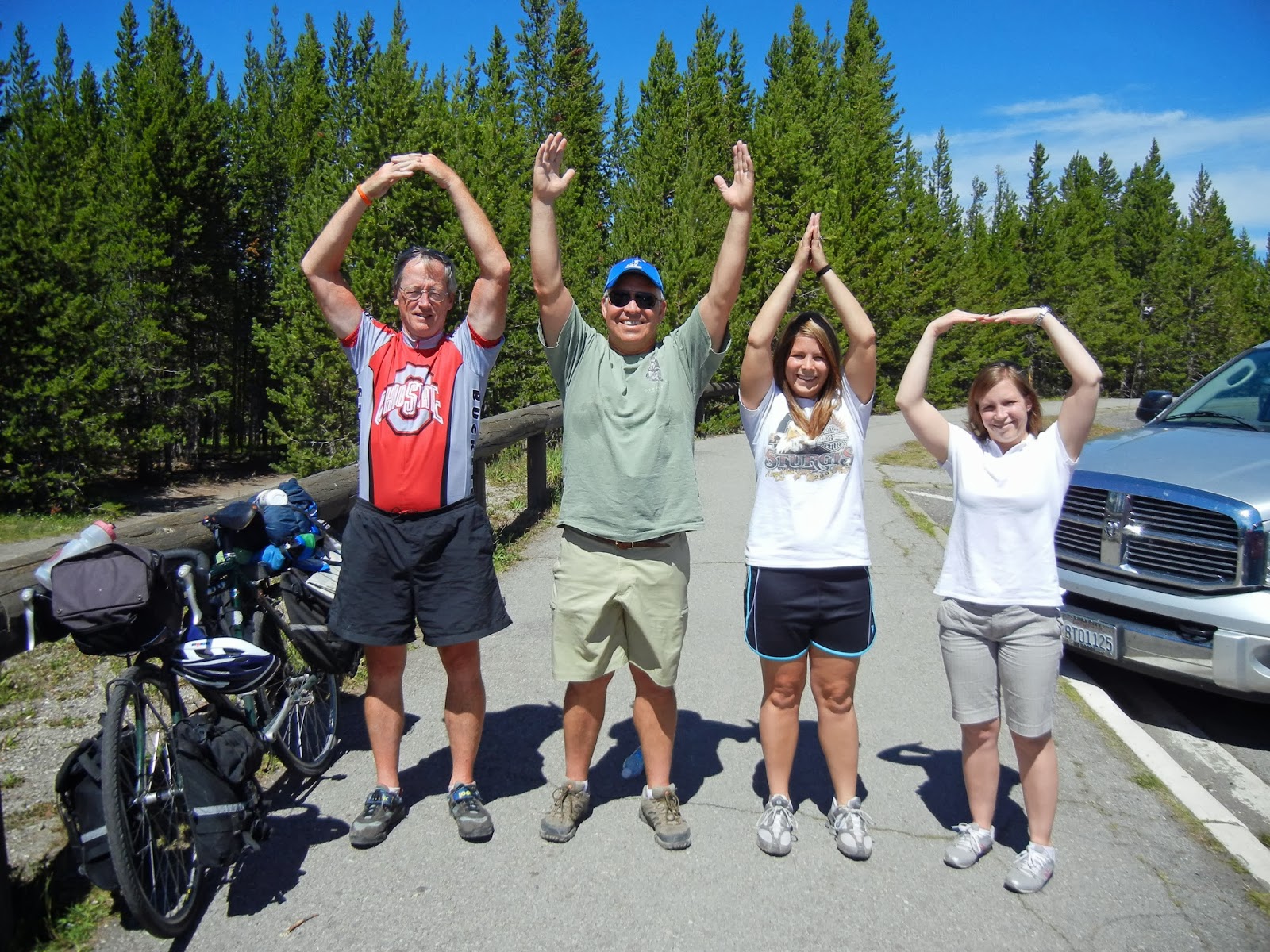
I always meet nice people when I'm pedaling. O-H-I-O.


I took a break in Salt Lake City to see the Mormon Tabernacle.


Somewhere in South Dakota.
This guy was working on his seventeenth cross-country trip.


My older brother Tim often rides with me part of the way
and helps me reach my destination in one piece.


This is Tioga Pass, leading up into Yosemite National Park.
Heck of a climb. There's a white speck on the road just above my handlebars.
That's a big RV camper to give you some scale.


Lake near the top of Tioga Pass.


When I pedal all day I can eat all I want and still lose weight.
Raspberry shake in Utah.


Okay, not all of America is pretty.
Sevier Desert in Utah.


One mile of elevation gained! Thirty-miles uphill to reach the top.

Outside of Buffalo, Wyoming.


On both trips across the U. S. I pedaled through Yellowstone.
I highly recommend that.


I don't recommend crashing in the dark, though.
(I got messed up looking for a campground that didn't exist
and had to keep pedaling to find a motel where I could stay.)


Camping in Yosemite Park.


Yosemite Valley. A great place to pedal; but the climb out is rough.


If you want to get a good idea of what the terrain in Nevada is like, along Route 50, The Loneliest Highway in America, the video below is good.


Wednesday, October 26, 2011

Pedaling for JDRF: The Big Payoff

Now that I've pedaled across the the United States twice, raising money for the Juvenile Diabetes Research Foundation both times, I thought it might be cool to post a few of my favorite pictures.  There's plenty out there to see.

And seeing it from the seat of your bicycle while raising money for a great cause is doubly satisfying.  My apologies:  the pictures are in pretty random order.

You have to do some serious pedaling to get up to Mt. Rushmore.
It's absolutely worth the ride.
I won't say I camped in the woods for free a mile from Mt. Rushmore.
It just appears that way.  And the four deer that watched aren't talking.
Bicycle through the Badlands and you can really appreciate the views.

Resting your tired feet by a New Hampshire river
can be a great pleasure.

I'm not going to lie:  getting rained on for four days in a row, while crossing New York:
that was NO fun.
To go up and over the Powder River Pass from Buffalo, Wyoming
you have to rise more than 5,000 feet in elevation, pedaling uphill for 33 miles.
The views make it all worthwhile--and you get to coast thirty miles down to Ten Sleep.
Powder River Pass, looking back the way I came; about the 22-mile mark pedaling uphill.
George checks out America.

View flying home from California.
It took four hours on a plane to undo weeks of pedaling.
 
Hay rolls in South Dakota.
It might not look like much:
but you can pedal along Interstate 90 in Wyoming if you want to.
Still one of my favorite "strange" sightings.

You don't have to be young to pedal across the USA.
Lord:  look at that gray hair.
Filtering water from a cold mountain stream.

I started my 2011 ride from Acadia National Park in Maine.
Scene from Cadillac Mountain.
In 2007, I started from Avalon, New Jersey.
I usually start, looking pretty fat.
Most riders start in the West, by the way, and ride east.

Pedaling a bicycle in Yosemite is an absolute pleasure.
Vernal Falls.

I met David Rothschild, 23, at a campground in Yellowstone.
The park service actually holds sites for hikers and bikers;
so you don't have to worry about where you stay.
David was great company for an evening--but riding east, headed for North Carolina.

One evening, near Richmond, Indiana, I threw up my tent and took cover during a downpour.
When the rain ended, I stepped out to call my wife. Police came flying up in cruisers
and temporarily handcuffed me as a suspect in an armed robbery. 
The getaway vehicle?
Photo taken at crossing of Mississippi River, near Clinton, Iowa.
I had the chance to see a crop dusting plane in action while pedaling in Indiana.
In 2007, I pedaled past the University of Virginia.
It's a beautiful campus.

What's not to like?
I pedaled through Leadville, Colorado in 2007,
and made my own camping spot near this mountain stream.
Elevation 10,000+ feet above sea level.
Look at this scene from the Yellowstone area.
Picture from Chuck Boehme, during his 2010 ride.
A good place to swim, near Togwotee Pass, Wyoming.
Hard going up; but a seventeen mile coast down to Grand Teton National Park.
Columbia River Gorge, Oregon, scene from 2007 ride.
The waterfall is more than 600 feet high.
Every pioneer needs a dependable automobile.
Blue Ridge Mountains of Virginia.
I've stayed in some ratty motels on my rides.
This one was in Fredricksburg, Virginia.
Lovely towel and furniture of about the same quality.
In some places the scenery is better than others:
I met Sarah Brigham pedaling in Wyoming in 2007.
She made the tutu herself.
I met these two young men, heading east in Kansas, in 2007.
They had a nice tail wind; and I didn't.
And I lost their names...
Grand Tetons, Wyoming (2007; 2011).
I rode with Rich Fowler for a couple of days in 2010,
when he pedaled across the USA at age 67.
He had a young guy for company:  Joe Ossman, 64.
Joe rode with me one day in Iowa, during my 2011 trip.
Gallatin River Valley, near Yellowstone.
Rafters on the Gallatin River.
A great place to stop and have lunch.
Bicycling in the Grand Teton area, 2011.
Grand Teton scene.

The famous Oxbow Bend in the Grand Tetons.

We can't seem to help ourselves:
Bicycle riders love to photograph themselves at state borders (2007 trip).
Standing on Royal Gorge Bridge in 2007;
I was tired and tempted to drop my bicycle over the side.
Glad I didn't though, for the next few days I pedaled north,
through the beautiful Arkansas River Valley.

While riding in Idaho, in 2007, I met Gene Meyers, 47, a computer programmer from Pittsburgh.
We headed west together for five days before splitting up.
He was headed for Seattle and I was aiming for Portland.
Gene carried his own cooking gear. 
I'm always too lazy.

Gene and I went 93 miles down the gorgeous Lochsa River Valley.
Mt. Hood, Oregon. 
You can actually ride I-84 down the Columbia River Gorge in Oregon.
Or you can use the old highway and make the climb to take a picture like this.
Either way, west winds comes howling up the Gorge, making eastward progress difficult.
I did a practice ride through the Gettysburg battlefield.  
This picture, near Little Round Top, a key position during the fight in 1863, I call "Butt Rock."
I thought the stone soldier looked lonely.
On another practice ride along the Blue Ridge Parkway, I rode with a nice couple from Alaska.
It was 2008, but they said they couldn't stand Sarah Palin.
I thought this looked like a dinosaur.
Near Starved Rock State Park, Illinois.
If you missed this story, my GPS device indicated there was a motel nearby.
I was in the middle of nowhere in Indiana and it was 100 degrees.
Unfortunately, the Dog Patch Motel turned out to be a kennel.
The owner was nice and let me sleep in the air-conditioned office.
Not "priceless," but only $20
I met Mike Frizoel and his wife Kathy in Peru, Illinois.
Kathy has been a type-1 diabetic since age 8, but her spirit is indominatable.
I rode with Rick Arnett for a few hours in Nevada.
He was going cross-country, too, but walked up the largest hills.  So away I went.
I do love Lupine; this is in Maine.
View from the motel balcony near Eureka, Nevada.
I call it "stealth camping."
Bar at Middlegate, Nevada.
When I turned south off Route 50 towards Gabbs, I went 36 miles without seeing a single house.
Old Faithful Inn in Yellowstone.
The all-wood architecture is always impressive.
By the time I got to Nevada, in 2011, it seemed easy to do three passes of six or seven thousand feet in one day.
Give it up for the Mormons.
They keep Salt Lake City looking beautiful.
Lion on building in Salt Lake City.
Statue of Joseph Smith, kneeling left,
founder of the Church of Jesus Christ of the Latter Day Saints.
I hung out with Sam and Sidney Staebler and their parents after I rode up to Bozeman, Montana.
Sidney is a type-1 diabetic.
And let's face it:  they're both cute.
Coming back from Bozeman, I got caught in the dark north of Yellowstone.
I kept pedaling long after the sun went down and crashed with obvious results.
Sunrise at Acadia National Park, near start of 2011 trip.
Sunrise over Bear Lake, Utah.
I was up early because I slept on a golf course and the sprinklers got me.
Where there's sunrise, there's also sun beating down.
Sunburned hand.
You can go a long way in Nevada and all you see is sagebrush in front of you.
And behind you.
And to the left.
And to the right.
I had a tire come apart unexpectedly in Gabbs, Nevada (pop. 349).
(Ray and Hazel Dummar, and waitress Wendy Traub pictured)
The owners of the R & H Cafe helped me find a ride to the nearest town with a bicycle shop.
In Nevada, it would have been nice to see a stream like this.
The Baker River, New Hampshire.
I love the way water has shaped this huge slab of granite, forming the river bed.
Bear Lake, Utah.
How many M.P.S. do you get?
Miles per shake.
Fueling up near Garden City, Utah.  I think it's the red raspberry capital of the world.
One of my favorite pictures from 2007 trip:  Wyoming, near Jeff City (pop. 50)
I liked the view so much, I camped out atop the hill that night.
I did a few practice rides in the Florida Everglades and Florida Keys
to get ready for my cross-country ride in 2011. 
Sunset near the Everglades.
Sometimes you just have to suck it up and pedal over those mountain passes.
In 2011, I was pedaling in the name of Lauren Lemmon, left, among others.
She's a type-1 diabetic from Columbus, Ohio.
Emily Lemmon, right.
I also rode for Matt Westendorf, who has been type-1 since age three.
He's heading for college soon.  So this isn't a recent picture.
Really:  I'm not being falsely modest.  I think a lot of people could pedal across America.
Half the time, in 2011, I trained by eatihg Macadamia Nut Clusters. 
Thanks, Costco.
What I mean is:  I'm not a training fanatic.
Lance Crowley was out on a pleaure excursion.
He was riding across Nevada for fun.
Colleen Zinn and husband Doug.
I met them crossing the Sevier Desert in southern Utah.
Colleen was finishing a cross-country ride she started 25 years ago.
Doug was supporting her ride.
My older brother, Tim, rode with me for several days in California, at the end of my 2011 trip.
I borrowed this picture from Tim Campbell,
 another serious rider.  Look at what you can see from the seat of a bike.
This is an old picture:  but that's a sequoia tree LIMB.
Why not pedal through the forests?
A tired rider pauses at the top of a long mountain pass,
somewhere in Utah.
Abandoned Mormon church in Ovid, Idaho.
Little patriot.
Catfish Festival Parade, Wilmington, Illinois.
I'm not going to lie:  I was proud of myself when I made it to the top of Tioga Pass,
coming into Yosemite National Park,
The pass requires a climb of 3100 feet in about ten miles.
If you have to pedal uphill to see this view,
then you pedal uphill.
Lake at the top of Tioga Pass.
Red flower in Yellowstone.
Blue pool in Yellowstone.
Orange thermophiles (heat loving algae),
Grand Prismatic Hot Springs, Yellowstone.
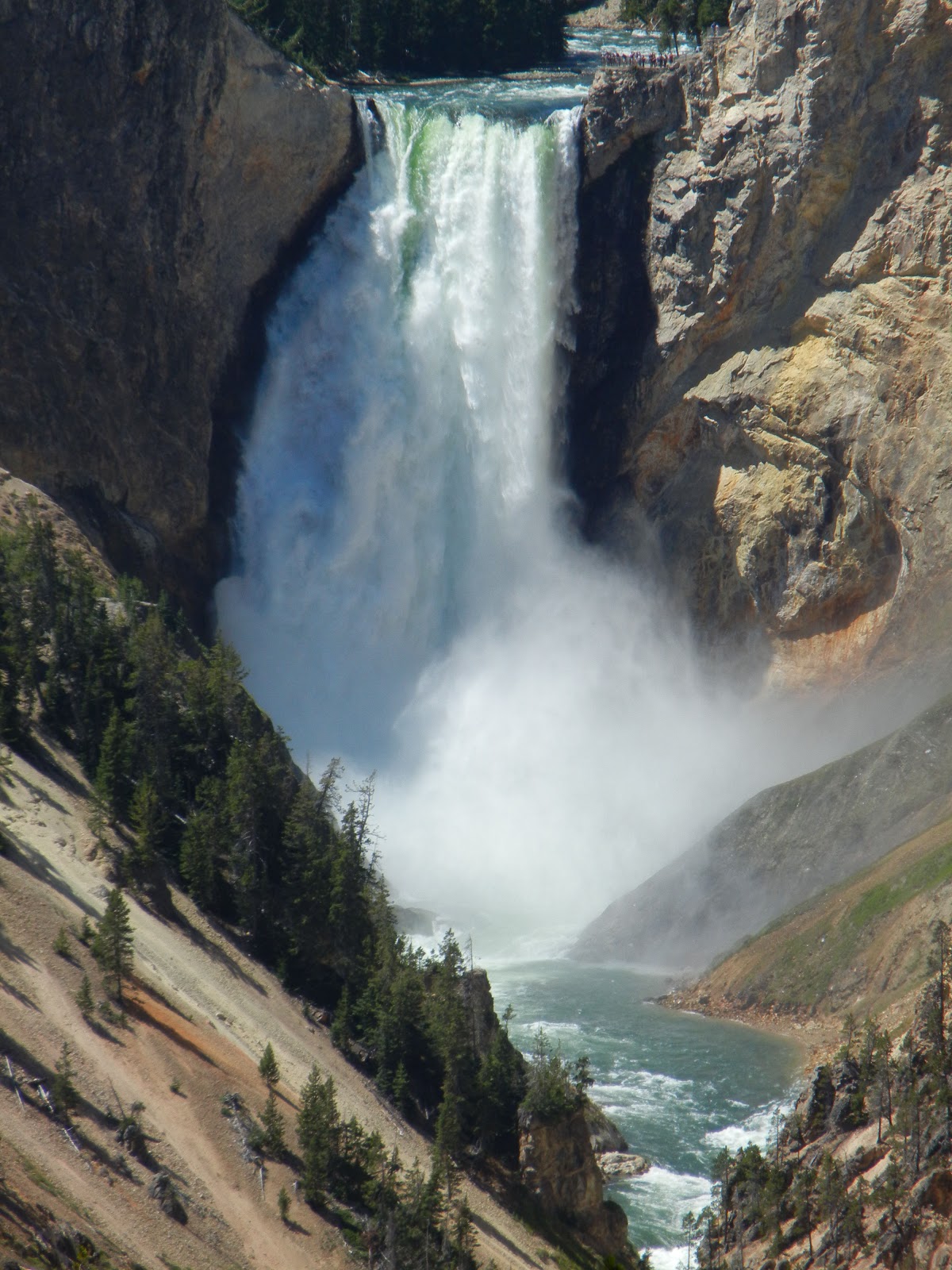
Green water:  Brink of Lower Falls of the Yellowstone.
Lower Falls of the Yellowstone River.
Note observation deck to right, top of falls.
Scene by the side of the road, Yellowstone, 2011.
Boys swimming in pool at base of Yosemite Falls,
I had to join them!
Crystal clear mountain stream in Yosemite Park.
Yosemite Falls drops 2,400 feet into the valley.
Picture from an earlier car trip.
Last day's ride in California, heading for San Francisco.
I've said it before:  I tend to start my rides out of shape.
Fat at the Bonnaroo Music Festival in June 2011.
I tend to end up looking thin.
San Francisco, September 7, 2011.
In the end, I always ride for my daughter Emily, now a senior in nursing at Ohio State.
She's been a diabetic since she was 14; and I want her to have a long, happy, healthy life.
EVERY DAY, AND ADDITIONAL 82 YOUNG AMERICANS
FIND OUT THEY HAVE THE TYPE-1 DIABETIC DISEASE.
If you would like to donate to help find a cure for type-1 diabetes please click HERE!

(This single click takes you to my fund-raising page. There, click again on "donate to this event." Then click "Biking and Painting for Diabetes."